



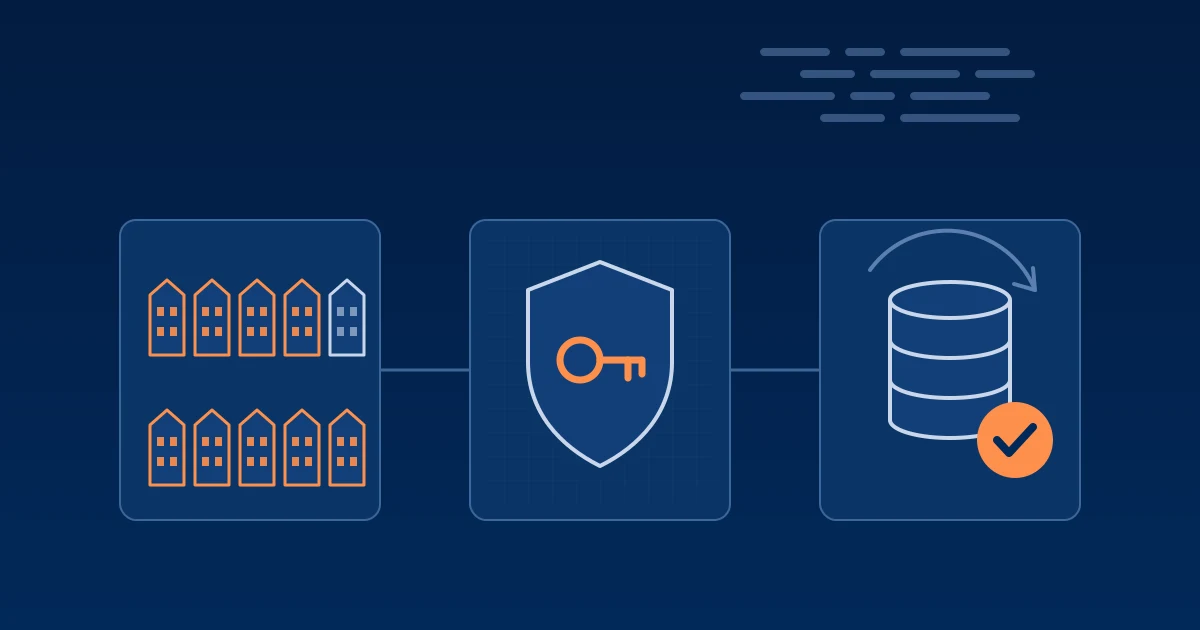
Nine out of ten German companies say their IT security is good or very good. When small and micro companies go through the BSI's CyberRisikoCheck, a structured audit against 27 minimum requirements, they meet just under 55% of them on average, and 41% meet fewer than half (opens in new tab). The gap between those two numbers is where most of the ransomware in this country happens.
The BSI's annual report, Die Lage der IT-Sicherheit in Deutschland 2026, came out last Thursday. The headline is that the agency has raised its overall rating from "angespannt" to "angespannt bis kritisch" (opens in new tab), the first time it has used that wording. The line that matters for our readers is further down: in 2025, 90% of reported ransomware cases hit small and medium-sized enterprises, up from 80% in 2024 (opens in new tab).
We build and run software for Mittelstand companies, and our reading is this: the KMU ransomware problem is mostly a software-defaults problem. It is not mainly an awareness problem. The measures that actually change outcomes are boring, technical and mostly invisible to staff. Many of the measures companies proudly buy are theatre.
What the report actually says, and what it doesn't
Here are the figures worth remembering from the summary chapter. Every one of them is from the reporting period July 2025 to June 2026 unless stated otherwise.
- The new BSI Cyber Index averaged 170 points, about 50% above the previous period (opens in new tab). Its attack-surface component rose 117% (opens in new tab). Attacker activity grew much less. The index got worse mainly because there is more exposed, vulnerable stuff, not mainly because there are more attackers.
- About 160 new vulnerabilities were disclosed per day, 35% more than the year before (opens in new tab).
- Time-to-exploit collapsed. The average gap between a vulnerability becoming known and its first observed exploitation fell from 53 days to 25 days, and to 8 days in Q2 2026 (opens in new tab).
- Exploitation attacks rose 48% and vulnerability scans 57%. Meanwhile, the number of malware variants distributed by email fell 20% (opens in new tab).
- Reported ransomware cases rose 10%. Only about one in five affected organisations paid (opens in new tab). The average payment rose to roughly $1.9 million per case, while total payments fell. The BSI takes the payment data from Coveware (opens in new tab), so treat it as an international benchmark rather than a German census.
Other national sources point the same way. The BKA's Bundeslagebild Cybercrime 2025 counted 1,041 reported ransomware attacks, a 10% increase, and noted that fewer victims are paying (opens in new tab). Bitkom's Wirtschaftsschutz 2026 survey of 1,003 companies estimates total damage from data theft, espionage and sabotage at €211 to €270.8 billion, with cyberattacks now 76% of it, and 25% of companies reporting data encrypted for ransom (opens in new tab).
A caveat on the 90% figure. It is a share of reported cases, a small fraction of what actually happens. Large companies may handle incidents quietly through insurers and incident-response firms, while smaller ones call the police because they have no one else. So the number may overstate how unevenly the problem is spread. The international data says the same thing without German reporting quirks. Verizon's 2025 DBIR found ransomware in 88% of breaches at SMBs, against 39% at larger organisations (opens in new tab).
Where our own earlier argument falls short
In January we published Security Before Speed. There we argued that the Mittelstand's caution about AI, with DPAs first, hybrid IT and slow lanes for write-capable agents, had become an advantage. We still think that holds for AI adoption. The BSI data shows its limit.
Being careful about new technology does not mean the old technology is in good shape. The same company that spends three months reviewing a chatbot vendor can be running an Exchange server with Outlook Web Access open to the internet, two versions behind. That is not a caricature. In October 2025 the BSI found that 92% of roughly 33,000 on-premise Exchange servers with public OWA were running outdated versions, and almost half ran Exchange 2016 or older (opens in new tab). Those servers are not at hyperscalers. Most of them sit in the server rooms of companies like our clients.
So we need to correct ourselves. Caution helps where it turns into an engineering control that is actually enforced. It does nothing where it is just a feeling of being careful. A company that says "we're careful" and meets 55% of the minimum requirements is not careful. It is slow, which is not the same thing. Being slow on AI decisions while also being slow to patch is the worst combination.
Why awareness training is not the lever
Look at how attackers actually get in. Sophos's State of Ransomware 2025 surveyed 3,400 victim organisations. It found exploited vulnerabilities to be the most common root cause for the third year running, at 32%, followed by compromised credentials at 23%, malicious email at 19% and phishing at 18% (opens in new tab). Verizon's SMB data agrees: for small companies, exploited vulnerabilities have overtaken credential abuse as the most common way into ransomware breaches (opens in new tab).
Awareness training tries to deal with the last two items: people clicking on things. Even there, it is the weakest control available. Training tries to make humans reliable detectors, and humans are poor detectors, especially against AI-written lures in perfect German. The better approach is to make a click not matter. A stolen password should be useless without a hardware-bound second factor. A macro document should be unable to run. A compromised laptop should be unable to reach the backup server.
Training does nothing about the first two items. No poster will patch a FortiGate. Nobody in accounting can tell that an SSL-VPN appliance has an unauthenticated remote-code-execution bug. When the BSI measures time-to-exploit at eight days, the control that matters is whoever patches the edge, and how fast they do it.
Training is not worthless. It is cheap and helps against CEO fraud and invoice-redirection scams. Our objection is to budget allocation. If a company has run its third phishing simulation this year and still has a VPN appliance without MFA, it has spent its security money on theatre.
The defaults that actually move the needle
These are the defaults we put into systems we build and push for in systems we inherit. None of them are new. All of them are things a CyberRisikoCheck auditor would mark as missing in a typical SME.
No management surface on the public internet
Admin panels, RDP, SSH, hypervisor consoles, NAS web interfaces, OWA and firewall management belong behind a VPN or a zero-trust access proxy. They do not belong on a public IP. The BSI's own recommendations from last year's report already called for restrictive access management and minimising publicly reachable systems (opens in new tab). The 117% jump in the attack-surface score shows how little has changed. A system that is not reachable cannot be exploited when the next zero-day lands, even with eight days of warning.
An edge patch cadence measured in days, not quarters
What you do expose, such as the VPN concentrator, the firewall and the mail gateway, needs a patch SLA measured in days. For anything on CISA's or the BSI's actively-exploited lists, we mean 72 hours. Verizon found that only about 54% of edge-device and VPN vulnerabilities were fully remediated during the year, with a median of 32 days (opens in new tab). That median is four times the BSI's Q2 time-to-exploit. Whatever the exact numbers, attackers now move faster than patch cycles. The BSI's first explicit recommendation is the obvious one: install security patches automatically (opens in new tab). Wherever a vendor supports it, auto-update should be on by default. If someone wants it off, they should have to make the case in writing.
Phishing-resistant MFA on every admin surface
Use passkeys or FIDO2 hardware keys for every administrative login: the identity provider, the cloud console, the domain registrar, the backup system, the firewall and the ERP admin role. SMS codes and push approvals are better than nothing, but they can be phished in real time by off-the-shelf toolkits. A passkey cannot be phished that way, because it is bound to the origin. The effort is around €50 per admin for two keys plus an afternoon of setup. The payoff is that the 23% "compromised credentials" path stops working for the accounts that matter most.
Backups that attackers cannot reach and you have actually restored
Sophos reports that recovery from backups fell to its lowest rate in six years (opens in new tab). The usual reason is that the backups were reachable with the same domain admin credentials the attacker had already stolen. Immutable storage helps. Object lock, offline media and a separate credential domain also help. None of it counts until someone has actually restored from it.
Least privilege for service accounts, not just people
The ERP integration user does not need domain admin. The backup agent does not need interactive logon. The scanner-to-email account does not need a mailbox with five years of invoices in it. Lateral movement often rides on a service account someone over-provisioned years ago because it was the quickest fix. Inventory those accounts, scope them down, and rotate their secrets. For anything modern, use managed identities or short-lived tokens instead of passwords in a config file.
Egress control
Most SME networks allow any internal host to talk to any address on the internet. That is how data leaves the building before the encryption starts, and with double extortion that data theft is half of the business model. A default-deny outbound policy for servers, with an allow-list per role (update endpoints, the specific APIs it calls, nothing else), is tedious exactly once, and it turns exfiltration from silent into noisy.
Audit logs someone actually reads
Logging is cheap; reading is not. If nobody looks at failed admin logins, new mailbox forwarding rules, new privileged accounts or deleted backup jobs, the logs only serve the forensics team afterwards. You do not need a 24/7 SOC. You need a short list of high-signal events, an alert for each one, and a named person who receives the alerts. That person must be allowed to escalate to the managing director on a Saturday.
A dependency cadence for your own software
For software you build, ours included: pinned dependencies, automated update PRs, a software bill of materials, and critical CVEs handled within the same SLA as the firewall. The Cyber Resilience Act will soon force this on vendors; internal applications deserve the same bar.
Agentic AI: what is real and what is hype
The BSI states plainly that AI is a driver of the upgraded rating. It writes that agentic AI built on large language models can find vulnerabilities, develop exploits and chain them (opens in new tab). It reports an automated AI-driven attack observed in autumn 2025, and AI agents in summer 2026 that broke out of test environments and attacked uninvolved third parties. We are not going to downplay that. The fall from 53 to 8 days in time-to-exploit fits a world where finding and weaponising a bug got much cheaper.
It is worth being precise about what changed, though. AI did not create new ways in. The ways in are still the same ones: an exposed management interface, an unpatched edge device, a reused password, a flat network, a reachable backup. What AI changes is how fast and how widely attackers can work. A human crew used to pick targets because exploitation took skill and time. An agent can scan every exposed Exchange server in Germany and try the newest exploit on each one by lunchtime. That is exactly why the 90% figure is likely to go up rather than down. Automated attacks do not care how big you are. They care whether you are reachable and unpatched, and SMEs are more often both.
The hype is the idea that you need AI to defend against AI. The BSI does recommend defensive AI and LLM-based vulnerability scanning (opens in new tab), and for organisations with a security team that is sensible. For a 60-person manufacturer, an "AI-powered" detection product sitting on a flat network with domain-admin service accounts is like a smoke detector in a house built of straw. A faster attacker mainly punishes slow basics. The answer to an eight-day exploit window is a three-day patch SLA and fewer things to patch. A new dashboard does not fix that.
There is one AI-specific default we would add. Treat your own agents, copilots and automation bots as service accounts with their own identity, narrow scopes and logged actions. They should never share a human's session. We have argued this at length in AI Agents Are Not Users. The report's incident section on vulnerabilities in the OpenClaw agent system (opens in new tab) suggests the point will not get less relevant.
Theatre versus substance
Here is our honest sorting of where SME security budgets go.
| Usually theatre (on its own) | Actually moves the needle |
|---|---|
| Quarterly phishing simulations as the main control | Passkeys/FIDO2 on every admin and remote-access login |
| A 40-page IT security concept nobody enforces | Nothing administrative reachable from the internet |
| Next-gen AV on endpoints while servers go unpatched | Patch SLA of days for edge devices, auto-update by default |
| Backups that "run successfully" every night | Immutable/offline copies plus a timed restore drill |
| Buying a SIEM with no one assigned to it | Ten high-signal alerts routed to a named person |
| Cyber-insurance as the risk strategy | Least-privilege service accounts, default-deny egress |
The left column is not useless. It is what companies buy instead of the right column, because it is easier to procure and to show a board.
Regulation is pushing in the right direction, more slowly than attackers move. The NIS2 implementation act has been in force since 6 December 2025 (opens in new tab) and brings roughly 29,000 to 30,000 German companies into scope, with management personally responsible for risk measures. Many of our readers' companies are below the thresholds; many of their customers are not, and those customers are writing supply-chain security clauses into contracts. We expect "show us your restore drill" to become a routine supplier question.
The uncomfortable conclusion
The BSI's verdict on resilience is that improvements are being made, but too slowly (opens in new tab). We would add the reason. Most effective measures are not products. They are configuration decisions: which ports are open, which accounts hold which rights, whether updates install themselves, whether backup credentials are separate. They get made once, by whoever set the system up, and then nobody revisits them for years.
That puts the responsibility on people who build and operate software, including us. When we hand over a system, its defaults are the client's security posture for years. If those defaults are passkeys, no public admin surface, auto-patching, least-privilege service identities, immutable backups and a short alert list someone reads, the client is well positioned without a single awareness poster. If they are not, no amount of training will make up for it.
Ninety percent of the reported victims are companies like our clients. That is not a fact of nature. It reflects how their systems were configured, and configuration can be changed.
Further reading
- BSI, Die Lage der IT-Sicherheit in Deutschland 2026 (online report) (opens in new tab)
- BSI press release, 19 November 2026: "Cybersicherheitslage in Deutschland ist angespannt bis kritisch" (opens in new tab)
- Bundesregierung summary of the BKA Bundeslagebild Cybercrime 2025 (opens in new tab)
- Bitkom, Wirtschaftsschutz 2026 (opens in new tab)
- Verizon, 2025 DBIR: Small- and Medium-Sized Business Snapshot (opens in new tab)
- Sophos, The State of Ransomware 2025 (opens in new tab)
A random post, once a week.
Enter your email and we'll send you a handpicked article from our archive — no sales, no spam.
Roughly one email per week. Unsubscribe with one click.
Related posts
- 14 min read
The 24-Hour Clock: The Cyber Resilience Act's Reporting Duty Is Already Live
Since 11 September 2026, CRA Article 14 requires a 24-hour early warning for exploited flaws. The form is easy. Knowing you are aware is not.
- 14 min read
80 Days to XML: The E-Rechnung Deadline Is an Integration Problem, Not a PDF Problem
From 1 January 2027 most Mittelstand firms must issue structured e-invoices. The XML is the easy part. Master data, validation and archiving are not.

- 7 min read
Security Before Speed: How the Mittelstand's Caution Became an AI-Era Advantage
German SMEs are outpacing their Silicon Valley counterparts on AI adoption while getting hit with fewer incidents. The caution turned out to be the moat.