



Thirty-five percent of teams have already replaced the functionality of at least one SaaS tool with something they built themselves, and 78% expect to build more in 2026 — per Retool's 2026 Build vs. Buy report (opens in new tab). The categories leading the wave are not exotic: workflow automations, internal admin tools, BI, CRMs.
We run a custom software shop, and "build vs. buy" is still the wrong framing — binary, one-shot. Every team we work with runs both. The useful question is: which functions should be SaaS, which should be custom, and where does the seam live?
The old framing is dead because the economics flipped
First, SaaS got expensive fast. Vertice's SaaS Inflation Index (opens in new tab) clocks pricing growth at more than four times the US CPI — peaking at 14% in May 2025 and still running 11–12% annualized into 2026, with cost per employee around $9,100 by year-end 2025.
Second, build got cheaper. Retool finds 51% have shipped production software using AI tooling, and about half save six or more hours a week. Internal tools that needed a five-person squad can now be carried by one senior engineer with good taste and a CI pipeline.
Meanwhile, the regulatory ground shifted. The EU Data Act (opens in new tab), in force since 12 September 2025, forces SaaS providers to allow termination with two months' notice, forbids exit fees, and requires data exports in a "structured, commonly used, machine-readable format." The default direction of gravity is finally away from lock-in.
What "commodity" actually means for software
A function is commodity when three things are true: customers would not notice if you switched providers tomorrow; the logic is industry-standard; and the rate of change matches the vendor's release cadence. Email, identity, payroll, sales-tax, e-signature, log aggregation, cloud infrastructure — commodity for 99% of companies.
The test we give clients: if the function were a truck, would you lease or buy? If every logistics company drives the same truck for the same job, you lease. If your truck has a hydraulic arm nobody else has, you buy. Most CRMs, helpdesks, and accounting systems are trucks. Order orchestration, pricing logic, compliance workflows — those are hydraulic arms.
What competitive advantage looks like in code
The opposite of commodity is anything that encodes a decision you made differently from competitors. Consider a Maschinenbau firm that prices spare parts on machine vintage, regional service density, framework-contract discounts and take-back credits. No SaaS CPQ fits without extensive customization — and the moment you customize SaaS you lose its main advantage.
The heuristic: if you can describe the workflow to an SAP consultant in a sentence, it's off-the-shelf. If it takes three whiteboards, it's yours to own. Gartner's composability research found high-composability companies projected ~7.7% revenue growth versus 3.4% for low-composability peers; a related forecast (opens in new tab) projected 30% higher revenue for composable finance organizations.
A five-point framework for drawing the line
Score each function on five axes. None is decisive alone; the pattern matters.
1. Differentiation
Does this function change how a customer experiences us versus a competitor? A generic "send an invoice" flow does not. A payment plan that adapts to seasonal cash flow of German landscaping firms does. If no, SaaS. If yes, custom — or custom orchestration on SaaS primitives.
2. Data ownership and gravity
The EU Data Act helps on paper; in practice, exporting ten years of nested CRM relationships is still a two-quarter project. For data feeding analytics, AI models, or regulatory reporting, default to custom storage with SaaS as a thin integration layer. Veeam's vendor lock-in analysis (opens in new tab) notes egress fees alone can cost five figures before engineering starts.
3. Integration depth
One or two systems, SaaS usually wins. Five or more — ERP, three product lines, a warehouse system, two payment processors, a compliance database — the integration is the system, and you'll want to own the orchestrator.
4. Change velocity
If your workflow changes faster than your vendor ships, you are the vendor's feature request queue, and you will lose.
5. Regulatory and residency fit
For German and EU Mittelstand, this is the tie-breaker. NIS2, Data Act, AI Act, GoBD all push toward systems you can audit end-to-end. The Bitkom Digitalisierung der Wirtschaft 2025 (opens in new tab) report found 53% of German companies report problems managing digitalization itself — much of that is compliance overhead.
Run those five for every function. The resulting heatmap is your composable architecture. Rarely pretty, almost always defensible.
Where SaaS quietly costs more than the sticker
The subscription is the smallest line item in TCO. Gartner's research (opens in new tab) holds that personnel and maintenance dwarf licence fees, and benchmarks put annual maintenance at 15–20% of build cost (opens in new tab) for custom. Three recurring hidden SaaS costs: integration drift (vendor APIs change ~every 18 months and you re-pay across the stack); workflow drift (by year three half your team has a spreadsheet doing the "real" work — Retool found 60% of builders admit to shadow IT, 64% of them senior managers); and exit cost (3–6 months of engineering even with the Data Act).
Worked example: BookMe vs. Calendly
BookMe is our website, CMS, and multi-step booking system for service businesses — we build each one, deploy it on the customer's own domain, and operate it. Every business runs the same codebase on its own isolated infrastructure, so standing one up is configuration rather than a rebuild: a single command provisions the database, the storage bucket and the secrets, and CI deploys it. That part takes hours, not weeks. What costs real time is a feature the platform does not already have — that has to be built and tested like any other software. And because each business is pinned to its own version of the codebase, that feature ships to the customer who paid for it without landing on anyone else. Calendly is a standalone booking tool, the SaaS primitive for slot-picking. They operate at different scopes: Calendly owns one flow, BookMe is the whole service-business web presence. So the real question isn't BookMe or Calendly — it's when a plain SaaS primitive is enough and when a customer needs a custom layer built around it.
If you are a consultant, small clinic, or recruiter where the booking flow is pick-a-person, pick-a-slot, send-an-invite — use Calendly. Differentiation zero, integration depth low, change velocity low. We tell people this and we mean it.
If the booking flow is the business, the calculation changes. A workshop or a practice needs the site the customer lands on, services with their own durations and opening hours, closures and holidays that actually block a slot, and customer records that stay in a database it controls. Calendly gives you a slot picker and a profile page on someone else's platform. That gap — the layer above the primitive, encoding what makes the business different — is what we build and what a customer should expect to pay for.
When we tell clients to stay on SaaS
The workflow is genuinely generic. A 30-person professional services firm asking for a custom CRM is better served by HubSpot or Pipedrive. We cannot beat their feature cadence.
The team cannot carry maintenance. A €120K build wants ~€20K/year to stay healthy. No engineering leadership, no CI, no plan for who owns the codebase in year three? Buy SaaS and hire a good integrator.
The regulatory surface is already covered. If every competitor uses the same two vendors, their compliance is a moat working in your favor. Payment card compliance is canonical — we'll build your checkout logic, but we will not operate the card vault.
The timeline is too short. Custom work is 9–15 months whiteboard to production. Six-month regulatory deadline? SaaS-plus-integration now, custom module as Phase 2.
A software shop that builds everything every client asks for is eventually a graveyard of half-loved systems. The right answer is almost always composable — commodity on SaaS rails, differentiation in code we own together, a clean seam, and a plan for what happens when either side shifts. That plan is the deliverable. Not the code.
Further reading
- Retool: The Build vs. Buy Shift — AI, Shadow IT, and the SaaS Replacement Era (2026) (opens in new tab)
- Vertice: SaaS Inflation Index (opens in new tab)
- Clairfield: How the 2025 EU Data Act rewrites the rules for SaaS providers (opens in new tab)
- Latham & Watkins: EU Data Act — Significant New Switching Requirements (opens in new tab)
- Bitkom: Digitalisierung der Wirtschaft 2025 (opens in new tab)
- Gartner: Managing Rising Software Costs (opens in new tab)
A random post, once a week.
Enter your email and we'll send you a handpicked article from our archive — no sales, no spam.
Roughly one email per week. Unsubscribe with one click.
Related posts
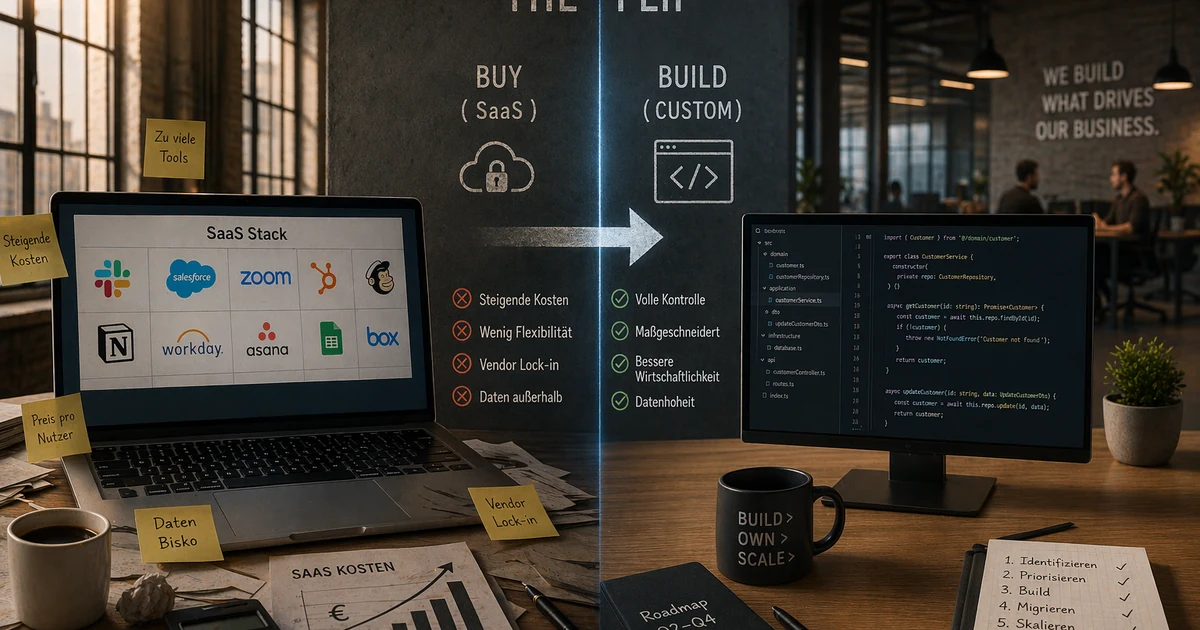
The 35% Flip: Why Teams Are Replacing SaaS With Custom Builds
The build-vs-buy math changed in 2024–2026. Here are the SaaS categories flipping first, a break-even model, and the ones to keep.

Comprehension Debt Is the Real AI Tax
AI-assisted engineers score 17% lower on comprehension of their own code. The codebase looks fine. The humans who shipped it can no longer reason about it under pressure.
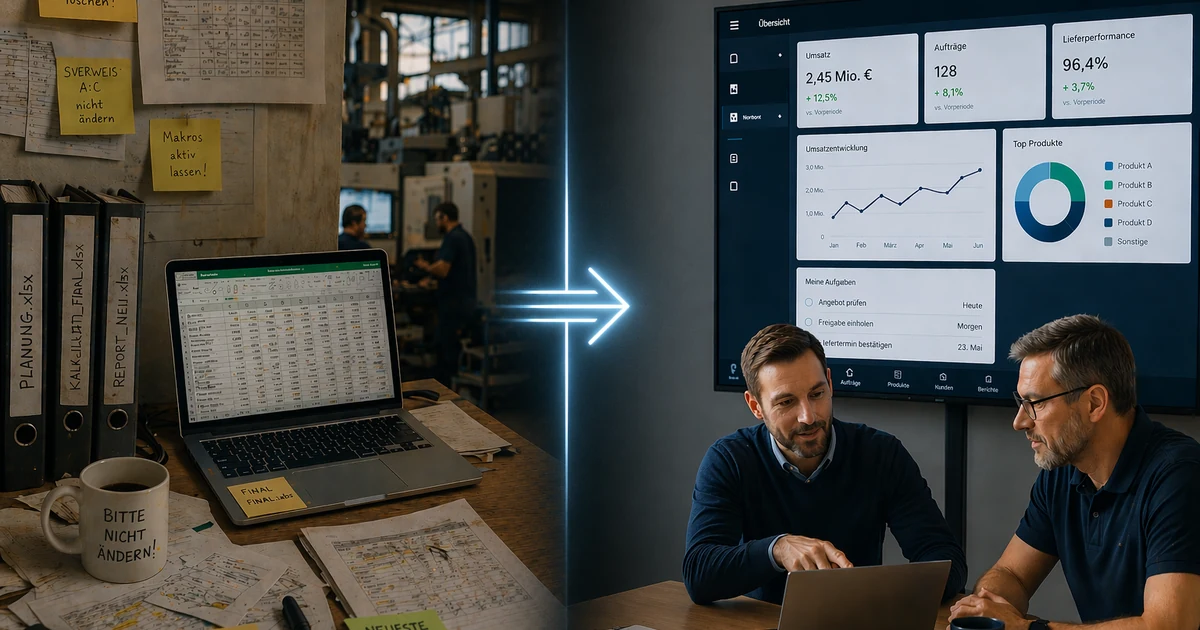
Killing the Excel Workflow: How Mittelstand Teams Actually Replace Spreadsheets
A pragmatic migration pattern for replacing the shared Excel file that runs your business — without breaking operations or forcing change management.