



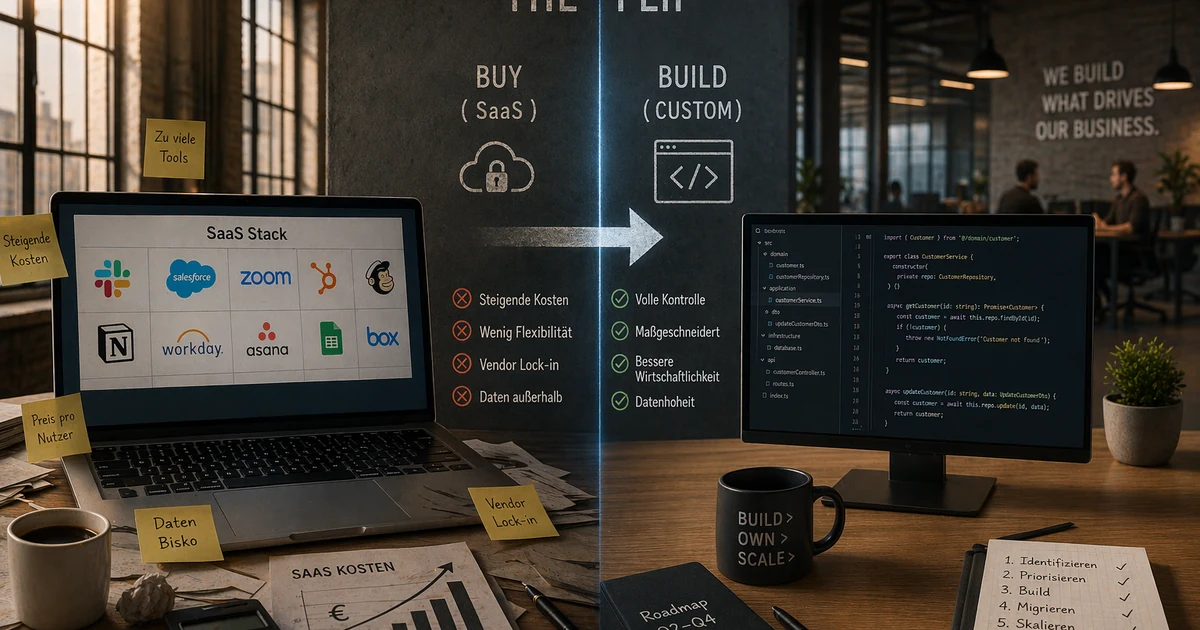
In February 2026, Retool published a number that made every procurement team open a spreadsheet: 35% of enterprises have already replaced at least one SaaS tool with custom-built software, and 78% plan to build more in 2026 (opens in new tab). Workflow automation (35%) and internal admin (33%) lead, with BI, CRM, and PM close behind.
For a decade the answer to "should we build this?" was no. That default is cracking — not because SaaS got worse, but because three things moved at once: pricing accelerated past inflation, AI collapsed glue-code cost, and Europe shifted toward portability. This post: which categories flip first, which to keep, what break-even looks like at €100k, and how teams rebuild SaaS badly.
What actually changed since 2019
Three curves crossed.
First, SaaS prices detached from inflation. Gartner forecasts worldwide software spending growing 14.7% in 2026 to $1.4 trillion (opens in new tab); CIOs earmark ~9% of IT budget just to cover renewals. Vertice put SaaS pricing at 11.4% YoY vs. 2.7% G7 inflation (opens in new tab) — Slack +20%, Zendesk +15%. Zylo reported the first rise in SaaS spend per employee in three years (opens in new tab), up 21.9% on AI add-ons.
Second, AI cheapened the boring 80%. Retool found 51% now ship production software with AI, 49% save six+ hours per week (opens in new tab). Zoominfo's Copilot saw a 33% acceptance rate and 72% satisfaction (opens in new tab); a 2025 METR trial (opens in new tab) found senior open-source devs 19% slower with AI. Not a silver bullet for hard code, but devastating on the CRUD forms, admin UIs, and pipeline glue that fill any SaaS tool.
Third, Europe legislated against lock-in. The EU Data Act took effect 12 September 2025 (opens in new tab); Chapter VI requires contracts to allow switching anytime, with a 30-day transition (opens in new tab), egress fees phased out, and data in interoperable formats — not a PDF export.
The threshold has moved.
The categories flipping first
Workflow automation (35%). Zapier, Make, Workato scale with task volume, so the bill grows with success. A custom engine on BullMQ, Inngest, or Temporal is a weekend for the first use case — and your agentic AI code lives there too, not in a vendor DSL.
Internal admin tools (33%). A custom Next.js admin on your production schema costs roughly five years of Retool seats and does not break when you add a column. Highest-ROI build we see.
Reporting and BI for the long tail (29%). Keep heavy BI for analysts. The 40 "just one chart" dashboards that justify Looker's per-viewer pricing are a SQL view plus a chart library.
Customer portals and onboarding flows. Off-the-shelf portals force your process into their model and want to own the customer relationship. Custom portals ship the exact five screens customers actually use.
Form builders, CRM edges, project management. Retool flagged CRMs and forms at 25%, PM at 23%. The vendor has 200 features; you use 8; the price is for the 200.
The test: differentiator, or commodity wired to your data? If commodity, the build math now works.
Which SaaS to keep
We are not SaaS nihilists.
Standards-driven plumbing. Email delivery, DNS, CDN, object storage, SSO, observability, payment rails. The moat is ISP relationships, edge networks, or PCI scope you do not want to own.
Payroll and tax. In Germany, Lohnsteuer, social-insurance reporting, and DATEV integration are a regulatory job. DATEV, Lexware, Personio: buy.
Core CRM spine — but not its edges. Salesforce-as-system-of-record stays; custom objects, approvals, portals, reports flip. Keep the spine, rebuild the tentacles.
Email/calendar, productivity, GRC. Microsoft 365, Google Workspace, audit tooling — a compliance gap dwarfs the license.
Video and real-time. Meet, Zoom, Teams, LiveKit. Infrastructure disproportionate to the value of owning it.
Rule of thumb: buy where the moat is infrastructure, compliance, or network effects. Build where the moat is "we built the form first."
The break-even model
A 400-person Mittelstand company pays €60,000/year for a workflow SaaS plus three internal-tool licenses, with a 12% renewal hint. Alternative: a €100,000 custom build — one senior, one mid-level, designer at 30%, six months, AI-assisted.
Year 1: €100k build + €60k SaaS (run both during cutover) = €160k. Year 2: cut SaaS, maintenance at 15–20% = €18k vs. €67k SaaS — save €49k. Year 3: €18k vs. €75k — save €57k. Cumulative: +€46k. Payback. Year 5: cumulative savings near €200k, and you own the code, schema, and runbook.
Three numbers carry it: SaaS inflation of 8–12% on renewal, consistent with Vendr and the SaaStr breakdown (opens in new tab); maintenance at 15–20% of build cost; and scope discipline — refusing to rebuild features you do not use.
The build playbook
1. Start with the workflow, not the UI. The reason to rebuild is that your workflow is not the vendor's. If it does not fit on one whiteboard, do not start.
2. Own the schema before the UI. Long-term value is data in a shape that matches your business. Resist mirroring the SaaS model — it serves their multi-tenant case.
3. Ship the thinnest slice that replaces one SaaS tab. One tab a single team can switch to on Monday. Production-usable within three weeks.
4. Run both systems during cutover. Dual-write for as long as it takes. A botched cutover costs lost weeks of operations-team trust.
5. Budget for the long tail. The last 10% of parity is 50% of the work. Plan MVP at 60% of feature set, with an explicit "not building" list in writing.
6. Feed the AI the right context. AI tools accept around 30–38% of suggestions in production (opens in new tab), concentrated in boilerplate. Keep humans on architecture, integrations, security. The METR trial (opens in new tab) is a warning: AI works best on greenfield commodity work, worst on deep unfamiliar codebases.
The four ways this goes wrong
Rebuilding the SaaS badly. Two engineers cannot rebuild 200 features. Enumerate what you actually used in the last 30 days and commit to only those.
Underestimating ops. SaaS hides auth, audit logs, backups, upgrades, monitoring, on-call. Budget 20% of engineering time for ops, forever.
Ignoring integrations. Map the three that actually matter (accounting, identity, one industry-specific) before you start. The rest were excuses to charge you.
Confusing custom with bespoke. Lean on Next.js, Postgres, Temporal/Inngest, BullMQ, Better Auth, shadcn/ui, Drizzle. You assemble components. Gartner tracks early composable adopters at roughly 80% faster feature deployment (opens in new tab) precisely because they stopped confusing "owned" with "from scratch."
The honest summary
The 35% figure is the new default: commodity SaaS wired to your proprietary data is now a candidate for replacement, and build cost has dropped enough that the math works on 2–3 years. The "yes, build" list is narrow — workflow automation, internal admin, long-tail reporting, customer portals, onboarding. The "no, keep" list — payroll, email, SSO, payment rails, core CRM spine — equally narrow.
Three curves: pricing up, build cost down, regulation toward portability. The teams winning picked two tools to insource in 2025, shipped one by Q4, and are quietly calculating 2026 savings while competitors negotiate the inflation clause. That is the flip — already priced into your next three years whether you act on it or not.
Further reading
- Retool — The Build vs. Buy Shift: AI, Shadow IT, and the SaaS Replacement Era (2026) (opens in new tab)
- SaaStr — The Great SaaS Price Surge of 2025 (opens in new tab)
- Gartner forecast — Worldwide Software Spending 2026 (via SaaStr) (opens in new tab)
- Zylo — 2025 SaaS Management Index (opens in new tab)
- IAPP — EU Data Act operational impacts and cloud switching (opens in new tab)
- ACM — Measuring GitHub Copilot's Impact on Productivity (opens in new tab)
A random post, once a week.
Enter your email and we'll send you a handpicked article from our archive — no sales, no spam.
Roughly one email per week. Unsubscribe with one click.
Related posts

Composable by Default: SaaS for Commodity, Custom for Competitive Advantage
A 5-point framework for drawing the SaaS/custom boundary, backed by 2025–2026 data on replacement rates, price inflation, and EU Data Act portability.

Comprehension Debt Is the Real AI Tax
AI-assisted engineers score 17% lower on comprehension of their own code. The codebase looks fine. The humans who shipped it can no longer reason about it under pressure.

Killing the Excel Workflow: How Mittelstand Teams Actually Replace Spreadsheets
A pragmatic migration pattern for replacing the shared Excel file that runs your business — without breaking operations or forcing change management.